Patent — available for licensing
Rapid Aero Modeling for Computational Experiments
A NASA invention available to explore as a licensing opportunity.
About this technology
Overview
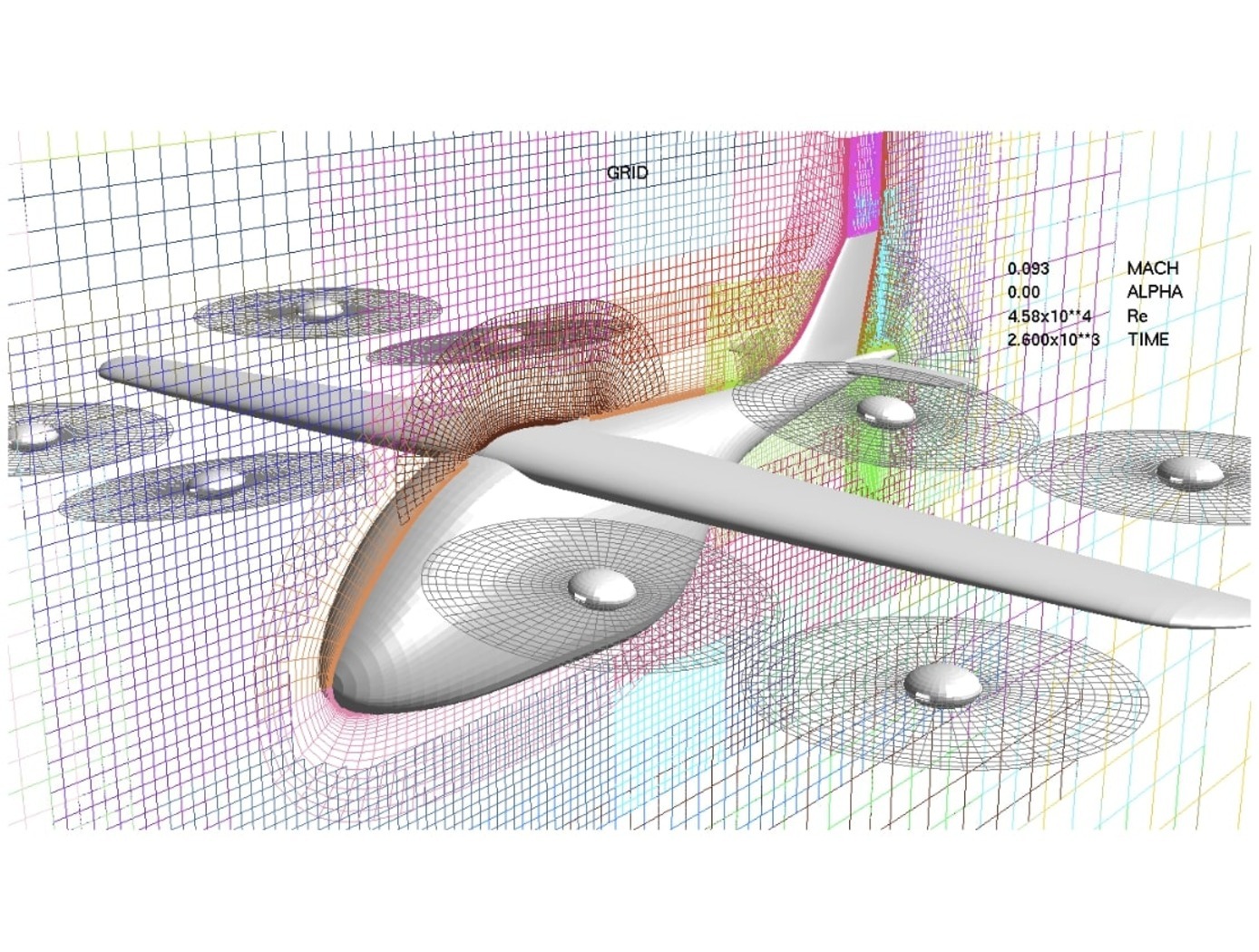
Aerodynamic modeling plays a critical role in the development of new aircraft, particularly for innovative designs aimed at urban air mobility (UAM) applications. This includes electric vertical takeoff and landing (eVTOL) aircraft, which combine features of conventional aircraft and rotorcraft. Such advanced designs offer a host of new capabilities but also introduce significantly increased complexity relative to conventional aircraft, including intricate nonlinear aerodynamic responses as well as interactions between propulsion and aerodynamic control systems. For the flight dynamics and controls disciplines, this added complexity renders detailed computational fluid dynamics (CFD) models unable to produce results fast enough for flight simulations. To address this challenge, NASA developed Rapid Aero Modeling for Computational Experiments (RAM-C), a software-implemented method capable of generating aerodynamic models that capture the important features of complex aircraft in a manner suitable for flight dynamics simulations. RAM-C can be thought of as a “wrapper” around computational (e.g., CFD) software, which it provides specific test inputs to, and receives aerodynamic measurements as outputs from. The input-output data are used to identify mathematical models and evaluate their statistical performance and fidelity. In essence, this NASA invention automates and streamlines the design phase for innovative aircraft while limiting computational requirements.